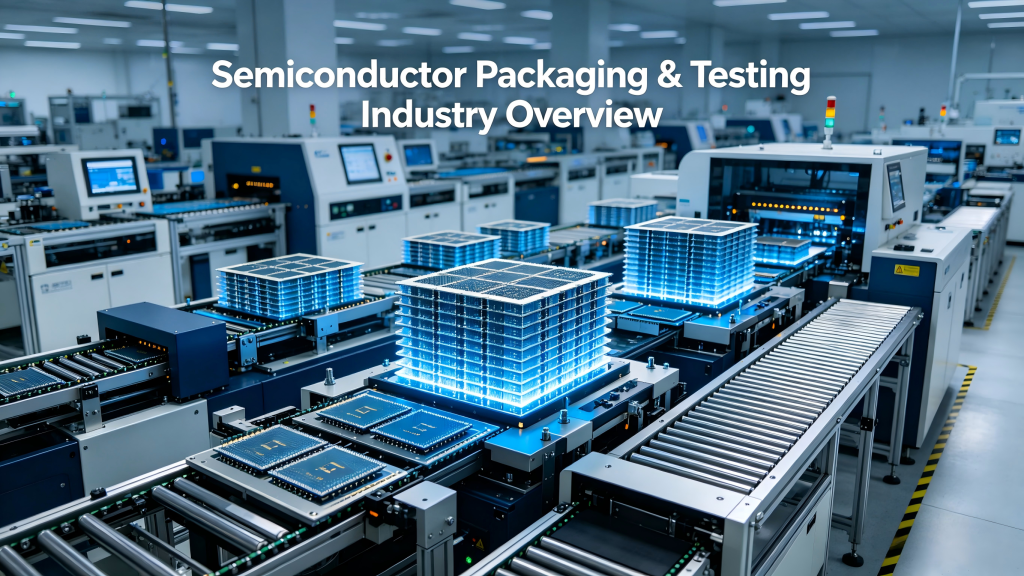
Since the beginning of 2026, the global semiconductor packaging and testing (OSAT) industry has ushered in a new cycle driven by AI computing power, advanced packaging innovation, and accelerated domestic substitution. From traditional packaging processes to the large-scale application of advanced technologies such as 2.5D/3D stacking, Chiplet, and HBM, the industry has achieved a fundamental reversal of supply and demand, with continuous price recovery and booming capital expenditure, stepping into a new stage of high-quality development.
I. Core Industry Trends: Supply-Demand Reversal, Advanced Packaging as the Key Competitiveness
1. Demand Side: High Prosperity Driven by AI Computing Power and Emerging Applications
AI large models, data centers, HPC, automotive electronics, and industrial control have become the core engines driving OSAT demand. AI servers require several times more CoWoS, Chiplet packaging, and HBM than traditional servers, leading to continuous tightness in TSMC’s CoWoS production capacity and order spillover to domestic advanced packaging manufacturers. According to a research report by Guosheng Securities, the OSAT capacity utilization rate has reached a high level by the end of 2025, and there is sufficient upward momentum in prices in 2026. SEMI predicts that the global semiconductor “trillion-dollar era” is expected to be realized ahead of schedule by the end of 2026.
2. Supply Side: Capacity Expansion + Technological Iteration, Concentrated Release of Advanced Packaging Capacity
- Accelerated Capacity Expansion by Domestic Leaders: Tongfu Microelectronics plans to raise 4.4 billion yuan to expand high-end packaging and testing; Changjiang Electronics Technology’s automotive-grade packaging and testing plant has been put into operation; Jinglong Technology’s high-end testing new plant has been commissioned; Yongxi Electronics, Huatian Technology, and other companies are accelerating the construction of advanced packaging production lines.
- Large-Scale Advanced Packaging Technology: Technologies such as CoWoS, TSV, hybrid bonding, and Panel-Level Packaging (PLP) have moved from verification to mass production. Huafeng Technology launched the world’s first 700×750mm panel-level packaging equipment AvantaGo L2, which increases substrate utilization by more than 30% compared with traditional 12-inch wafers and increases production capacity by about 8 times.
- Improved Domestic Supporting Rate: In Q1 2026, the domestic supporting rate of advanced packaging in China reached 68%, an increase of 7 percentage points month-on-month, and the entire chain of equipment, materials, and packaging and testing has entered a positive cycle.
II. Technological and Market Hotspots: Advanced Packaging Boom, Domestic Substitution Breakthrough
1. Advanced Packaging: The “Hidden Ace” of AI Chips, Fierce Global Competition
- CoWoS/HBM as Standard Configuration: AI chips from NVIDIA, AMD, and other companies widely adopt CoWoS packaging. ASE plans to double its advanced packaging revenue from 1.6 billion US dollars to 3.2 billion US dollars in 2026.
- Chiplet as the Mainstream Route: Tongfu Microelectronics provides 5nm Chiplet packaging for AMD MI300, with orders scheduled until 2027; Changjiang Electronics Technology, Shenghe Jingwei, and other companies are accelerating the layout of Chiplet and 2.5D/3D stacking.
- Panel-Level Packaging (PLP) for Cost Reduction and Efficiency Improvement: Large-size square substrates replace circular wafers, solving the pain points of low utilization rate and high cost, and becoming the mainstream solution for mid-to-low-end advanced packaging.
2. Domestic Substitution: Driven by Policies and Market, Breaking Overseas Monopoly
- Policy Support: The Chinese government has continuously introduced industrial policies to encourage OSAT technological innovation and domestic substitution, and standardize industry development.
- Rise of Domestic Leaders: Shenghe Jingwei is sprinting for the Sci-Tech Innovation Board. As the 10th largest OSAT company in the world and the 4th largest in China in 2024, its revenue growth rate leads among the top 10 in the world; Tongfu Microelectronics, Changjiang Electronics Technology, and Huatian Technology remain in the top 10 in the world, with their advanced packaging share continuing to increase.
- Breakthrough in Materials/Equipment: The localization of special gases, packaging substrates, bonding materials, and other products is accelerating. In response to supply chain fluctuations caused by the situation in the Middle East, OSAT factories ensure shipments through diversified layouts.
3. Segmented Tracks: Automotive-Grade, Memory, and Advanced Testing Become Growth Engines
- Automotive-Grade Packaging and Testing: The electrification and intelligence of automobiles drive the demand for automotive-grade chips. The automotive-grade production lines of Changjiang Electronics Technology and Tongfu Microelectronics are running at full capacity, and the AEC-Q100 certified capacity is continuously expanding.
- Memory Packaging and Testing: The price increase and capacity expansion of DRAM, NAND, and HBM have led to a surge in memory packaging and testing orders, and the demand for advanced testing equipment has exploded.
- Advanced Testing: Yongxi Electronics, Liyang Chip, and other companies are increasing investment in high-end testing to meet the complex testing needs of AI chips, and testing yield and efficiency have become core competitiveness.
III. Challenges and Opportunities: Supply Chain Fluctuations + Technological Iteration, Intensified Industry Differentiation
1. Core Challenges
- Supply Chain Risks: The situation in the Middle East affects the supply of special gases, raw material prices fluctuate, and OSAT factories face increasing cost pressure.
- Technological Barriers: Advanced packaging equipment and materials still rely on overseas supply, there is a shortage of high-end talents, and it is difficult to improve yield and control costs.
- Intensified Competition: Global OSAT factories are accelerating capacity expansion, price wars are imminent, and small and medium-sized manufacturers face the pressure of elimination.
2. Development Opportunities
- Long-Term Dividend of AI Computing Power: The iteration of AI large models and the construction of computing power infrastructure continue to drive the demand for advanced packaging, and the high prosperity of the industry is expected to continue until 2027.
- Golden Window for Domestic Substitution: Tight overseas production capacity and increased demand for supply chain security have allowed domestic OSAT factories to accelerate the seizure of global market share, and the localization of equipment and materials has entered a period of rapid penetration.
- Technological Integration and Innovation: The in-depth integration of packaging and testing with wafer manufacturing and design, and technologies such as Chiplet, SiP, and heterogeneous integration have opened up new growth space.
IV. Future Outlook: 2026-2027, Advanced Packaging Dominates the Industry Pattern
- Technological Trends: 3D stacking, hybrid bonding, and panel-level packaging will be fully popularized; Chiplet will become the mainstream solution for mid-to-high-end chips; HBM+CoWoS will become the standard configuration for AI chips.
- Market Pattern: The global share of domestic OSAT leaders will continue to increase, the proportion of advanced packaging revenue will exceed 50%, and small and medium-sized manufacturers will transform towards specialization and differentiation.
- Industrial Ecology: The entire chain of packaging and testing, design, manufacturing, equipment, and materials will collaborate; domestic substitution will move from single-point breakthrough to systematic leadership, and China will become the core base of global advanced packaging and testing.